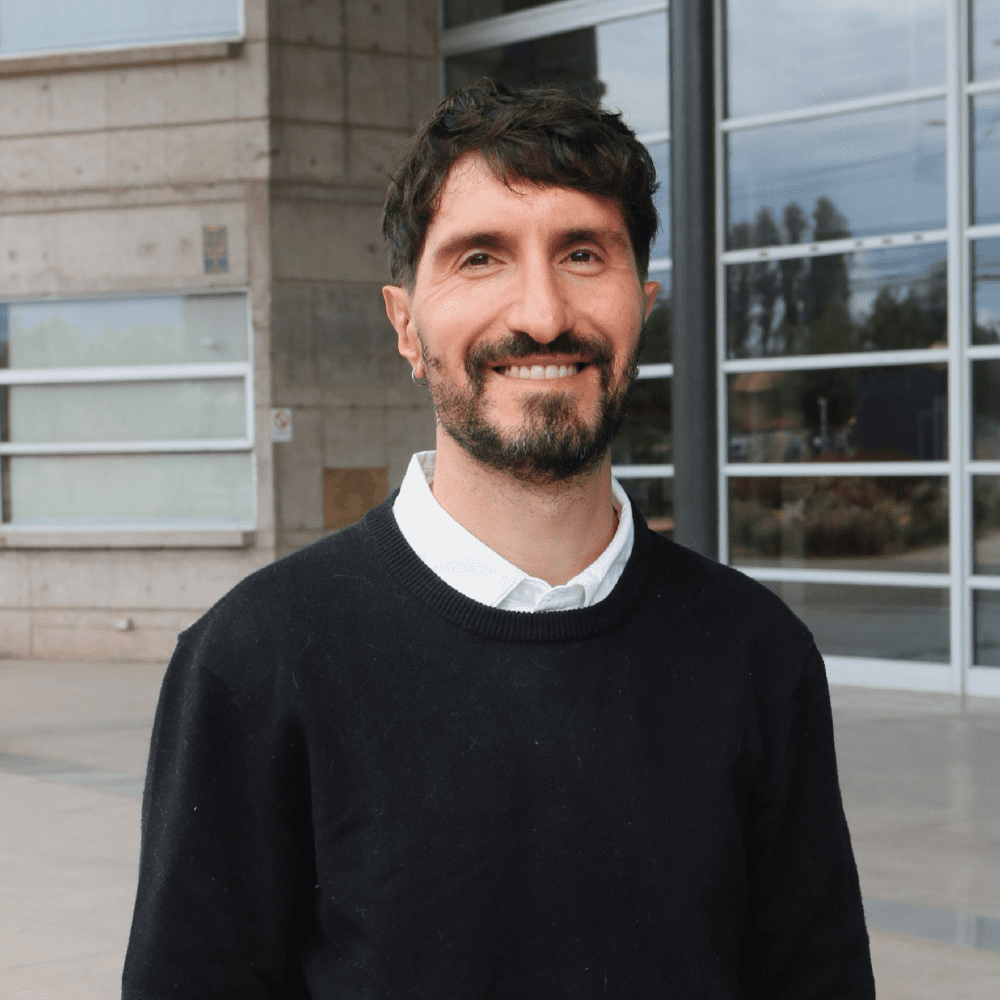
Marcos Macchioli-Grande Profesor Asistente

    Grado Académico

    Doctor en Ciencias Geológicas, Universidad Nacional de Córdoba (Argentina).

    Título(s) Profesional

    Licenciado en Geoquímica, Universidad Nacional de La Plata (Argentina).

    Descripción

    Marcos es investigador de la Zona Crítica Terrestre (la capa más externa de la Tierra, que se extiende desde la parte superior del dosel vegetal hasta el límite de los acuíferos libres), y ha trabajado especialmente en hidrología y geoquímica de cuencas de montaña. Su objetivo es entender los procesos hidrológicos, en particular la generación de escorrentía y el flujo sub-superficial en ríos de montañas en climas desde húmedos a semiáridos, incluyendo cuencas boscosas, estudiando las fuentes de agua y su flujo en el continuo atmósfera-roca/suelo-arroyo-(planta). Asimismo, busca comprender la generación y liberación de solutos en los ríos a partir de la interacción agua-roca, así como los factores que los controlan, tales como las tasas de meteorización y el tiempo de residencia del agua en el basamento, a través de las relaciones concentración-descarga. La metodología implica mediciones continuas de variables hidro-meteorológicas (precipitaciones, nivel freático, caudal, humedad del suelo) y el uso de múltiples trazadores ambientales, como iones mayoritarios, elementos traza (relación Ge/Si), isótopos estables del agua (18O/16O y 2H/1H), e isótopos radiogénicos (87Sr/86Sr), entre otros. Para alcanzar estos objetivos, he estudiado cuencas graníticas en la Sierra de Velasco (Sierras Pampeanas, Argentina), cuencas boscosas Mediterráneas en los Apeninos Toscanos (Italia), y actualmente cuencas en los Andes de Chile Central.

    2

    • 3220318
    • Abril 2022 - Abril 2025
    FinalizadoAgencia Nacional de Investigación y Desarrollo - ANID

    Concentration-discharge patterns in a Mediterranean watershed under increasing drought: insights on solute and water sources and fluxes, and chemical weathering rates in the Maipo River, Central Chile

    This project seeks to investigate the concentration-discharge patterns across the Maipo river, a Mediterranean watershed which is the main water source to Chile’s Metropolitan region. The study of the variation of solute concentration in different discharge scenarios (low-flow during dry season vs high-flow during wet seasons) will provide insights on the hydrological behavior of the catchment (chemostatic vs chemodynamic) and to quantify chemical weathering rates. Moreover, this proposal will identify solute sources and water pathways to assess their contribution to streamflow in the Maipo watershed. Finally, results from this proposal will allow us to investigate the processes involved in the region’s Critical Zone, which extends from the canopy top to the water table, and their response to climate change, especially during drought events. Solute generation from chemical weathering reactions, and their release and transport in rivers is of vital importance in the study of water resources. Understanding solute dynamics can provide insights on global chemical weathering rates, besides forecasting hydrogeochemical composition and thus, water quality under different hydrological scenarios. This is a key point in the context of climate change in Mediterranean catchments, where drought events are on the rise. Therefore, identifying water sources in streamflow and how they respond in different hydrological conditions can contribute to understanding the dynamics of water storages and fluxes through the Critical Zone. This information can be used directly for water management and governance. Given the importance of understanding water through the Critical Zone in Mediterranean mountainous watersheds, several questions arise: –What are the dominant water sources feeding streamflow in a mountainous Mediterranean catchment? –What are the main sources and fluxes of solutes and what are the chemical weathering rates in Mediterranean rivers? –What are the concentration-discharge patterns in Mediterranean Chilean Rivers? To address these questions, I propose to analyze the concentration-discharge patterns of major ions in the Maipo basin, in the Región Metropolitana, along with the study of other environmental tracers such as water stable isotopes. To do so, I will conduct monthly field sampling campaigns, to measure instantaneous discharge and collect water samples geochemical analyses of major ions and water stable isotopes. The Maipo basin is properly instrumented, giving the opportunity to develop models with long-term discharge data, and integrate hydrological and geochemical results. The results will be used to calculate concentration-discharge patterns. Additionally, the data obtained from the geochemical analysis will allow the calculation of chemical weathering rates. Finally, I will develop hydrograph separation models using historical discharge data and the newly generated water stable isotopes and major ions datasets, to investigate the effects of drought events in solute sources and water pathways. These results will provide new insights on solute dynamics, water sources and hydrological response of the Critical Zone experiencing progressive drought in mountain Mediterranean catchments, and also to provide a geochemical baseline on hydrochemistry and weathering rates for watersheds in Central Chile.
    Investigador/a Responsable
    • PIN 27/A056
    • Enero 2022 - Diciembre 2022
    Finalizado

    El ion fluoruro como trazador geoquímico e hidrológico en cuencas montañosas semiáridas: Comparación con otros trazadores geoquímicos e isotópicos

    Las montañas semiáridas constituyen la fuente primordial de agua para las poblaciones ubicadas en zonas pedemontanas. La sierra de Velasco, en el NO de Argentina es una sierra semiárida, compuesta por un basamento cristalino mayormente granítico, cuya meteorización aporta de solutos a las aguas que entregan sus cuencas, entre ellos el ion fluoruro. Este ion, perjudicial para la salud de las personas, presenta concentraciones superiores a los niveles permitidos en las cuencas del norte de la sierra y en la cuenca del río Huaco, en su sector central. Dado que la evaporación supera a la precipitación en este tipo de ambientes, es esperable que la carga de solutos se incremente aguas abajo, producto de concentración evaporativa. El objetivo de este proyecto es comprender la dinámica de la concentración y el flujo total del fluoruro a lo largo de la cuenca del río Huaco para determinar su sensibilidad ante los procesos hidrológicos en su variación. A su vez, se evaluará su potencial como trazador hidrológico y geoquímico comparativamente a otros iones como el cloruro y la composición de los isótopos estables de H y O del agua (2H/1H y18O/16O), para comprender dichos procesos en montañas semiáridas. Adicionalmente, mediante el uso de estos trazadores naturales en combinación con la medición del caudal se podrá estimar el rendimiento hídrico de la cuenca, lo cual es fundamental para la gestión y manejo del recurso.
    Investigador/a Responsable