
23
David Sossa ● Profesor Asistente
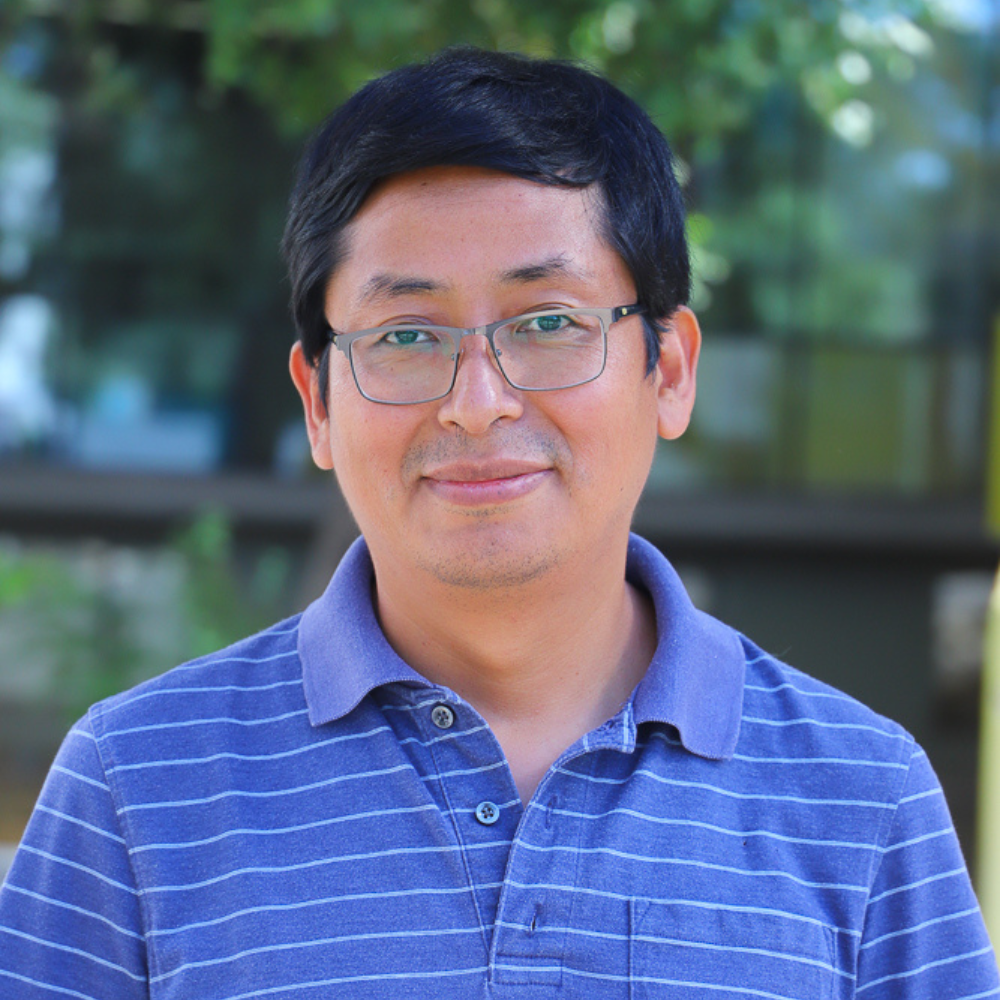
Grado Académico
Doctor en Ciencias de la Ingeniería con mención en Modelación Matemática.
Título(s) Profesional
Matemático
Descripción
David Sossa obtuvo su Licenciatura en Matemática en la Universidad Mayor de San Simón, Bolivia. En 2014 recibió los grados de Doctor en Ciencias de la Ingeniería con mención en Modelación Matemática, Universidad de Chile, y Doctor en Matemática Aplicada, Universidad de Avignon, Francia. Posteriormente, realizó un postdoctorado en la Universidad Técnica Federico Santa María y desde el 2017 es Profesor Asistente en la Universidad de O’Higgins. Los trabajos de David se desenvuelven principalmente en el área de Optimización en donde ha hecho aportes en tópicos como álgebras de Jordan para optimización, programación cónica, desigualdades variacionales y problemas de complementariedad, autovalores complementarios de grafos.
David, integra el área del Instituto de Matemáticas y Aplicaciones
4
- REVISTA Journal of Optimization Theory and Applications
- 2026
Computing the Least Cone-Constrained Singular Value of Matrices
• David Sossa Aguirre • Giovanni Barbarino • Nicolas Gillis
- REVISTA Electron. J. Linear Algebra
- 2026
Hidden commutativity in semi-FTvN systems
• David Sossa Aguirre • M. Seetharama Gowda
http://dx.doi.org/https://journals.uwyo.edu/index.php/ela/article/view/10069
- REVISTA SIAM J. Optimization
- 2026
Measuring dissimilarity between convex cones by means of max-min angles
• Welington de Oliveira • Valentina Sessa • David Sossa Aguirre
- REVISTA SIAM Journal on Optimization
- 2025
Commutation principles for nonsmooth variational problems on Euclidean Jordan algebras
• Juyoung Jeong • David Sossa Aguirre
- REVISTA Linear Algebra and its Applications
- 2025
Pareto singular values of Boolean matrices and analysis of bipartite graphs
• Alberto Seeger • David Sossa Aguirre
- REVISTA Discrete Mathematics
- 2024
Graphs sharing an arbitrary number of ordered complementarity eigenvalues
• David Sossa Aguirre • Vilmar Trevisan
- REVISTA Journal of Optimization Theory and Applications
- 2024
Computing Critical Angles Between Two Convex Cones
• Wellington de Oliveira • Valentina Sessa • David Sossa Aguirre
- REVISTA Linear Algebra and its Applications
- 2023
A Fiedler-type determinantal inequality in Euclidean Jordan algebras
• David Sossa Aguirre
- REVISTA Positivity
- 2023
Singular value problems under nonnegativity constraints
• David Sossa Aguirre • Alberto Seeger
- REVISTA Set-Valued and Variational Analysis
- 2023
Singular Value Analysis of Linear Maps Under Conic Constraints
• David Sossa Aguirre • Alberto Seeger
- REVISTA AUSTRALASIAN JOURNAL OF COMBINATORICS
- 2023
Infinite families of connected graphs with equal spectral radius
• Alberto Seeger • David Sossa Aguirre
http://dx.doi.org/https://ajc.maths.uq.edu.au/pdf/87/ajc_v87_p258.pdf
- REVISTA AUSTRALASIAN JOURNAL OF COMBINATORICS
- 2022
Complementarity eigenvalues as tools for determining connected graphs
• Alberto Seeger • David Sossa Aguirre
http://dx.doi.org/https://ajc.maths.uq.edu.au/pdf/84/ajc_v84_p220.pdf
- REVISTA Graphs and Combinatorics
- 2021
Measuring similarity between connected graphs: the role of induced subgraphs and complementarity eigenvalues
• Alberto Seeger • David Sossa Aguirre
- REVISTA Linear and Multilinear Algebra
- 2021
Vertex-removal, vertex-addition, and different notions of similarity for vertices of a graph
• Alberto Seeger • David Sossa Aguirre
- REVISTA Linear and Multilinear Algebra
- 2021
Spectral radii of friendship graphs and their connected induced subgraphs
• Alberto Seeger • David Sossa Aguirre
- REVISTA Graphs and Combinatorics
- 2019
Extremal Problems Involving the Two Largest Complementarity Eigenvalues of a Graph
• Alberto Seeger • David Sossa Aguirre
- REVISTA Linear Algebra and its Applications
- 2019
On cardinality of complementarity spectra of connected graphs
• Alberto Seeger • David Sossa Aguirre
- REVISTA Mathematical Programming
- 2018
Weakly homogeneous variational inequalities and solvability of nonlinear equations over cones
• M. Seetharama Gowda • David Sossa Aguirre
- REVISTA Journal of Optimization Theory and Applications
- 2016
On the Central Paths in Symmetric Cone Programming
• Héctor Ramírez Cabrera • David Sossa Aguirre
- REVISTA TOP
- 2015
Critical angles between two convex cones I. General theory
• Alberto Seeger • David Sossa Aguirre
- REVISTA TOP
- 2015
Critical angles between two convex cones II. Special cases
• Alberto Seeger • David Sossa Aguirre
- REVISTA Journal of Global Optimization
- 2014
Complementarity problems with respect to Loewnerian cones
• Alberto Seeger • David Sossa Aguirre
- REVISTA SIAM Journal on Optimization
- 2013
Commutation Principle for Variational Problems on Euclidean Jordan Algebras
• Héctor Ramírez Cabrera • Alberto Seeger • David Sossa Aguirre
- 23-MATH-09
- Enero 2024 - Diciembre 2025
En EjecuciónAgencia Nacional de Investigación y Desarrollo - ANID
Matrices, Optimization and Randomness with applications to Data Science
The research project "Matrices, Optimization, and Randomness with Applications in Data Science (MORA-DataS)" is composed of research teams from Bolivia, Chile, France, and Peru. This project is funded by the regional program MATH-Amsud in cooperation with UMSA (Bolivia), ANID, CMM (Chile), MEAE (France), and CONCYTEC (Peru).
The aim of this project is to study diverse optimization models, deterministic and stochastic, and to investigate various problems in matrix analysis with potential applications in data science. Some of the research topics are computing angles between convex cones, inverse eigenvalue problems, proximal algorithms for symmetric cone optimization, nonlinear second-order cone programming problems, nonsmooth joint chance constrained optimization problems, and Euclidean Jordan algebras for optimization.
Investigador/a Responsable
- Marzo 2022 - Febrero 2025
En Ejecución
Commutation principles and some variational problems involving spectral sets and functions on various invariant systems
The project deals with commutation principles in Euclidean Jordan Algebras, Normal Decomposition systems and Fan-Theobald-von Newman systems. It propose to deal with the generalization of these principles and the application to variational analysis and the Marcus-de Oliveira determinantal conjecture.
Investigador/a Responsable
- Abril 2020 - Febrero 2022
Finalizado
Image Modeling and Processing for REmote SenSing in agriculture (IMPRESS)
The field of remote sensing is experiencing an unprecedented acceleration. Besides the large public programs such as Sentinel (see e.g. https://sentinel.esa.int/web/sentinel/missions/sentinel-2), private actors are creating fleets of micro-satellites capable of monitoring of the earth with daily revisits. This abundant and cheap data is creating opportunities for developing novel applications for the monitoring of industrial and agricultural activity. The automatic exploitation of this data is bound to specific application domain knowledge, which requires a mastery of advanced techniques such as computer vision and machine learning, as well as expert knowledge in the field of agriculture. To do this, the team must master earth observation satellites, be able to define the adequate mathematical detection theories, and build on a deep knowledge of satellite image processing, while also including expert knowledge in agriculture. This project aims at uniting competences across the fields of computer vision and machine learning, remote sensing to address emerging applications in agronomy. This project will in addition foster the creation of reproducible research by adopting a reproducible research methodology thus contributing the resulting algorithms to the journal Image Processing On-Line (IPOL). The IPOL journal is an initiative to establish a clear and reproducible state-of-the-art in the domain of image processing and computer vision.
Co-Investigador/a
- Noviembre 2014 - Octubre 2017
Ejecutado
Variational Problems Under Conic Constraints
Co-Investigador/a
Mail de contacto